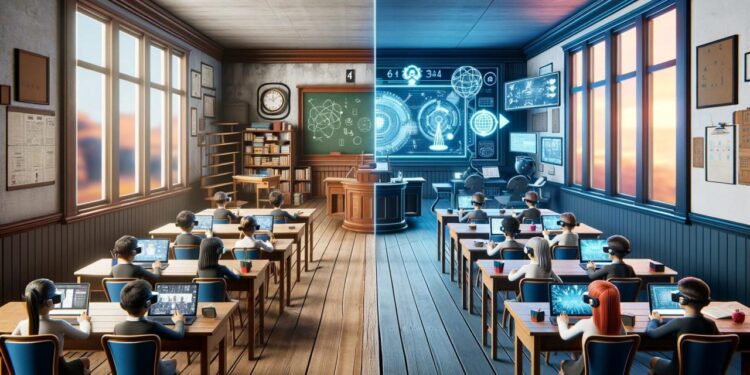
Imagine attending a lecture on the molecular structure of a virus not from a textbook, but from inside the cell itself, watching proteins interact in a three-dimensional dance. Envision a history class where you don’t just read about ancient Rome, but you walk through a faithfully reconstructed Forum, hearing the echoes of senators and the bustling of the marketplace. This is not a scene from a science fiction movie; it is the imminent future of higher education, propelled by the advent of the Metaverse. We are standing at the precipice of an educational revolution where the boundaries of physical campuses are dissolving, giving way to immersive, dynamic, and limitless digital worlds known as Metaverse Universities. This transformative shift promises to democratize access, personalize learning, and fundamentally alter the very nature of pedagogy, creating a new paradigm for how knowledge is acquired and shared.
The term “Metaverse” has become a buzzword, but in the context of education, it signifies a collective virtual shared space, created by the convergence of virtually enhanced physical reality and physically persistent virtual reality. It is a universe of interconnected digital environments where users, represented by avatars, can interact with each other and with digital objects in real-time. A Metaverse University is the institutionalization of this concept a fully-functional higher education ecosystem existing within this persistent virtual space. It leverages a suite of cutting-edge technologies, including Virtual Reality (VR), Augmented Reality (AR), Mixed Reality (MR), blockchain, and artificial intelligence, to create a comprehensive academic experience that rivals, and in some aspects surpasses, the traditional model.
A. The Core Technologies Powering the Virtual Campus
To understand the potential of Metaverse Universities, one must first deconstruct the technological pillars that make them possible. These are not singular technologies but a synergistic stack that creates a seamless and interactive experience.
A. Virtual Reality (VR) and Immersive Learning: VR headsets transport students from their living rooms into fully digital environments. This is the foundation for immersive simulations. Medical students can perform virtual surgeries on anatomically precise holograms, engineering students can deconstruct and reassemble complex machinery, and art students can sculpt in 3D space with virtual clay. The sense of “presence” the feeling of actually “being there” is a powerful catalyst for engagement and memory retention.
B. Augmented Reality (AR) and the Enhanced World: While VR creates a new world, AR overlays digital information onto the physical world. Imagine an architecture student pointing their tablet at a building and seeing its structural load paths animated, or a linguistics student seeing vocabulary labels float on objects around them in a foreign language. AR bridges the gap between the abstract and the tangible, enriching the physical learning environment.
C. Blockchain and Academic Sovereignty: Blockchain technology provides the backbone for trust and verification in the Metaverse University. It can be used to create unforgeable digital diplomas, certificates, and micro-credentials. Furthermore, it enables a transparent record of a student’s entire learning journey, from individual assignment submissions to skill-based badges. This gives learners true ownership of their educational records, which they can share securely with employers or other institutions.
D. Artificial Intelligence (AI) and Personalized Avatars: AI plays a dual role. First, it powers intelligent tutoring systems and adaptive learning platforms that can tailor curriculum to each student’s pace and comprehension level. Second, AI can animate non-player characters (NPCs) and even sophisticated teaching avatars, providing 24/7 academic support, acting as virtual lab assistants, or simulating historical figures for interactive dialogues.
E. Spatial Computing and Haptic Feedback: This refers to the ability of computers to understand and interact with the 3D space around them. Combined with haptic feedback suits and gloves, this technology allows students to “feel” digital objects. A geology student could feel the texture of a virtual mineral, and a dental student would experience the resistance of a virtual drill on a tooth, adding an unparalleled layer of realism to practical training.
B. The Tangible Benefits: Why the Shift is Inevitable
The move towards Metaverse Universities is not merely a technological gimmick; it is driven by profound advantages that address core limitations of the current educational model.
A. Democratization of Global Education: The most significant benefit is the obliteration of geographical and socioeconomic barriers. A brilliant student in a remote village can now attend a lecture at a top-tier university without the prohibitive costs of relocation, visas, and tuition associated with international study. This fosters a truly global classroom with diverse perspectives, enriching discussions and cultural exchange.

B. Unprecedented Experiential Learning: Theory and practice merge in the Metaverse. Instead of reading about gravitational physics, students can manipulate variables in a virtual solar system. Instead of watching a video about marine biology, they can embark on a guided dive through a coral reef ecosystem. This “learning by doing” approach leads to deeper cognitive understanding and superior knowledge retention compared to passive learning methods.
C. Hyper-Personalized Educational Pathways: AI-driven analytics can monitor a student’s progress in real-time, identifying areas of struggle and strength. The curriculum can then dynamically adapt, offering additional resources, alternative explanations, or more challenging material. This ensures that no student is left behind and every student is sufficiently challenged, moving away from the one-size-fits-all lecture model.
D. Safe and Controlled Simulation Environments: The Metaverse provides a consequence-free zone for practicing high-stakes skills. Student pilots can crash a virtual plane and learn from their mistakes without risk. Aspiring public speakers can address a virtual audience of thousands to overcome glossophobia (fear of public speaking). Medical professionals can practice rare emergency procedures repeatedly until they achieve mastery, something impossible to do in the real world due to ethical and practical constraints.
E. Enhanced Collaboration and Social Interaction: Virtual campuses can host brainstorming sessions in digital think-tanks, international team projects in custom-built environments, and virtual social hubs for networking. Spatial audio technology allows for natural conversations where sound behaves as it does in real life softer at a distance, clearer up close making interactions more authentic and productive than in a standard video call.
F. Reduced Operational and Environmental Footprint: While the initial tech investment is significant, Metaverse Universities can lead to long-term savings on physical infrastructure, utilities, and maintenance. Furthermore, by eliminating the need for daily commutes for millions of students and staff, the model presents a more sustainable, lower-carbon future for education.
C. Navigating the Virtual Frontier: Challenges and Ethical Considerations
Despite its immense promise, the path to mainstream adoption of Metaverse Universities is fraught with challenges that must be proactively addressed.
A. The Digital Divide and Accessibility: The reliance on high-end VR/AR equipment and high-speed internet risks creating a new form of educational inequality. If access to the Metaverse is gated by expensive technology, it could exacerbate existing social divides, leaving underprivileged communities further behind. Universities and policymakers must prioritize making this technology affordable and accessible.
B. Data Privacy and Psychological Security: Existing in a virtual university means generating vast amounts of biometric and behavioral data—where you look, how long you linger on an object, your physiological responses. The ownership, security, and ethical use of this data are paramount. Robust regulations are needed to prevent misuse, profiling, and unauthorized surveillance.
C. Identity, Harassment, and Digital Citizenship: The anonymity or pseudonymity afforded by avatars can lead to new forms of cyberbullying, harassment, and toxic behavior. Establishing clear codes of conduct, developing effective digital moderation tools, and fostering a culture of respect within virtual communities is a non-negotiable prerequisite.
D. The Risk of Sensory Overload and Mental Health: Prolonged immersion in intense virtual environments could lead to sensory overload, disorientation, or “cybersickness.” The blurring of lines between the physical and virtual worlds might also have psychological consequences, including social isolation and difficulty re-engaging with reality. Balancing screen time with real-world interaction will be crucial.
E. Academic Integrity and Assessment: How do you prevent cheating in a virtual exam? New methods of proctoring and authentication are required. The focus may need to shift from memorization-based tests to project-based assessments and the evaluation of practical skills demonstrated within the simulation, which are harder to fake.
F. Curriculum Standardization and Quality Control: As new virtual institutions emerge, ensuring the quality and accreditation of their programs will be a challenge. Global standards for Metaverse-based education need to be developed to protect students from subpar programs and ensure their qualifications are recognized.
D. A Glimpse into the Virtual Classroom: Use Cases Across Disciplines
The applications of Metaverse Universities span nearly every academic field. Here are a few concrete examples:
-
Medicine: Students collaborate in an operating theater, each controlling an avatar to perform different parts of a complex surgical procedure on a virtual patient with realistic physiology and bleeding.
-
History and Archaeology: A class explores a digitally reconstructed ancient Egyptian pyramid, not as it is today, but as it was at the time of its completion, with vibrant paintings and artifacts in place, led by an AI guide embodying a high priest.
-
Engineering and Architecture:
-
Civil engineering students walk through a scaled-up model of a bridge they designed, identifying stress points in real-time as virtual traffic flows over it.
-
Architecture students can not only design a building but also experience its acoustics, lighting at different times of day, and even how people would naturally move through the space.
-
-
Business and Soft Skills: MBA students participate in a hyper-realistic business negotiation simulation with AI-driven avatars representing different cultural and corporate backgrounds, providing a safe space to practice and receive immediate feedback on their tactics and communication style.
-
Fine Arts: A music class can be transported inside a symphony, with visualizations of the different instrument sections, allowing students to see and hear how harmonies and melodies intertwine.
E. The Road Ahead: A Hybrid and Evolutionary Path
The future of Metaverse Universities is not necessarily a wholesale replacement of physical campuses. The most likely and effective model is a hybrid one, often called the “phygital” approach. Students might attend some lectures in person for social connection and hands-on lab work, while participating in complex simulations, international collaborations, and specialized elective courses within the Metaverse.
The transition will be evolutionary. We will first see individual courses and modules adopting VR simulations, followed by entire programs being offered by fully virtual institutions. Traditional universities will establish “digital twin” campuses, allowing remote students to have a campus experience. The key to success will be a human-centric design using technology to enhance, not replace, the vital mentorship and human connection that lie at the heart of great education.
In conclusion, the arrival of Metaverse Universities is a watershed moment for global education. It presents a future where learning is not confined by walls, limited by resources, or standardized for the average. It is a future of boundless exploration, profound personalization, and experiential depth. While the challenges of access, privacy, and well-being are significant, the potential to unlock human potential on an unprecedented scale is undeniable. The virtual lecture hall is being built, and it promises to be a place of wonder, innovation, and limitless possibility. The question is no longer if this future will arrive, but how quickly we can prepare to embrace it responsibly and inclusively.