The digital revolution that began with classical computing is on the cusp of its next, and perhaps most profound, leap forward with the advent of quantum computing. This is not merely an incremental improvement in processing speed; it represents a fundamental paradigm shift in how we process information, leveraging the bizarre and counterintuitive principles of quantum mechanics. While headlines often focus on the race for quantum supremacy among tech giants and nations, a quieter, yet equally critical, revolution is brewing in the realm of education. The future of quantum computing is inextricably linked to our ability to cultivate a global workforce equipped with the knowledge and skills to harness its power. This article delves deep into the emerging trends that are shaping quantum computing education, exploring how we will teach, learn, and prepare for a quantum-enabled world.
A. Why Quantum Education is No Longer Optional
To understand the urgency behind quantum education, one must first grasp the transformative potential of the technology itself. Classical computers use bits a stream of electrical or optical pulses representing 0s or 1s. Every app, website, and video game is built upon this binary foundation. Quantum computers, however, use quantum bits, or qubits.
A. The Qubit Revolution: Unlike a classical bit, a qubit can exist in a state of 0, 1, or both simultaneously. This phenomenon, known as superposition, is the first pillar of quantum advantage. Imagine being able to explore a vast maze by taking every possible path at once, rather than one at a time. This is the power superposition grants quantum computers for specific problem types.
B. Entanglement: A Spooky Connection: The second pillar is entanglement, a “spooky action at a distance” as Einstein called it, where two qubits become inextricably linked. The state of one instantly influences the state of the other, no matter how far apart they are. This allows for a level of parallelism and correlation that is impossible for classical systems.
C. The Quantum Advantage: This unique combination enables quantum computers to solve certain classes of problems exponentially faster. This isn’t about making your video games render more quickly; it’s about tackling grand challenges that are currently intractable:
* Drug Discovery and Materials Science: Simulating molecular interactions at the quantum level to design new pharmaceuticals, fertilizers, and superconductors.
* Cryptography and Cybersecurity: Breaking current encryption standards while simultaneously creating new, unbreakable quantum-safe cryptographic systems.
* Logistics and Optimization: Revolutionizing supply chain management, financial modeling, and air traffic control by finding optimal solutions from billions of possibilities.
* Artificial Intelligence: Accelerating machine learning algorithms and uncovering patterns in vast datasets that are currently invisible.
Given this immense potential, a failure to invest in quantum education would be akin to failing to teach people how to use personal computers in the 1980s. The quantum literacy gap is a real and growing threat to economic and technological competitiveness on a global scale.
B. Foundational Trends Reshaping Quantum Pedagogy
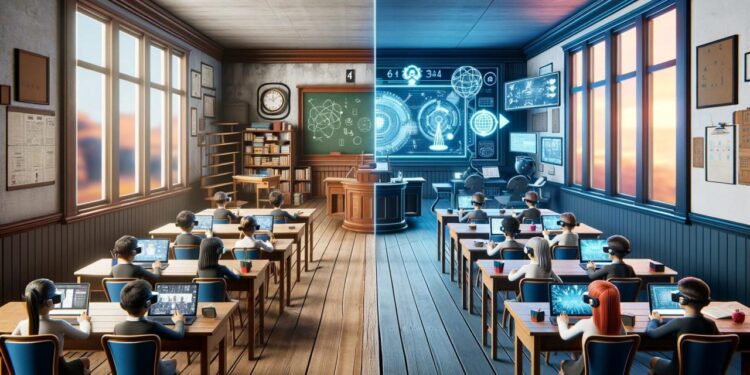
The way we teach quantum computing is evolving from advanced, abstract physics lectures to more accessible, interdisciplinary, and hands-on approaches. These foundational trends are making the field more inclusive and preparing a broader range of professionals.
A. Democratization Through Abstraction and Software Focus
The initial barrier to quantum computing was the immense complexity of the hardware superconducting loops, ion traps, and cryogenic systems. The emerging trend is to abstract this hardware complexity away, much like how most programmers today don’t need to understand transistor physics to build an app. The focus is shifting to the software stack. Educational programs are now introducing students to:
* Quantum Programming Languages: Languages like Qiskit (from IBM), Cirq (from Google), and Q# (from Microsoft) are becoming the Python and C++ of the quantum world. They provide high-level interfaces to design quantum circuits and run them on simulators or real hardware via the cloud.
* Cloud-Accessible Quantum Processors: Companies like IBM, Rigetti, and IonQ offer cloud-based access to their quantum processors. This means a student in a classroom anywhere in the world can run code on a real quantum computer, a revolutionary development that demystifies the technology and provides practical experience.
B. The Rise of Interdisciplinary “Quantum Native” Programs
The stereotype of a quantum scientist as solely a physicist is rapidly dissolving. The future belongs to interdisciplinary experts. We are seeing the birth of dedicated degree programs and courses that blend:
* Computer Science: For algorithm design, software engineering, and compiler development.
* Mathematics: For linear algebra, probability, and complex number theory, which form the mathematical backbone of quantum states.
* Engineering: For both hardware development (electrical, mechanical, chemical) and the control systems required to operate quantum machines.
* Domain Specialties: Chemistry, biology, finance, and logistics. A “quantum for chemists” course will focus on quantum simulation applications directly relevant to that field, rather than on the abstract physics of qubits.
C. Gamification and Visualization Tools
Quantum phenomena are notoriously difficult to intuit. How do you visualize a qubit in superposition? Educational innovators are tackling this through sophisticated visualization software and gamification.
* Interactive Simulations: Platforms like IBM’s Quantum Composer and open-source libraries allow users to drag and drop quantum gates, build circuits, and see the resulting state vectors and probabilities in real-time.
* Serious Games: Game-based learning environments are being developed where players solve puzzles by applying quantum principles like superposition and entanglement. This “learning by doing” approach builds a visceral, intuitive understanding that lectures alone cannot provide.
D. Stratified Learning Pathways: From Citizen to Expert
Recognizing that not everyone needs to be a quantum hardware engineer, education is becoming stratified to cater to different career goals:
* Quantum-Aware Citizens: Basic literacy for policymakers, investors, and the general public, focusing on what quantum computing is, what it can and cannot do, and its societal implications.
* Quantum Software Developers: Professionals who can use existing quantum programming frameworks to implement algorithms and solve domain-specific problems without needing a PhD in physics.
* Quantum Scientists and Engineers: The deep experts who will advance the underlying theory, design new algorithms, and build the next generation of quantum hardware.
C. The Evolving Educational Ecosystem: Where Learning Happens
The infrastructure for quantum education is expanding beyond the traditional university lecture hall, creating a diverse and accessible ecosystem.
A. Massive Open Online Courses (MOOCs) and Virtual Bootcamps
Platforms like Coursera, edX, and FutureLearn have been instrumental in the early democratization of quantum knowledge. Universities and companies partner to offer specialized courses and professional certificates. Intensive, weeks-long bootcamps provide a fast-track for software developers and professionals to reskill and enter the quantum workforce.
B. Corporate Academies and University-Industry Partnerships
Tech leaders like IBM, Google, and Microsoft are not just building quantum computers; they are building the talent pipeline to use them. They offer extensive educational resources, certification programs, and developer conferences. These industry-academia partnerships ensure that curricula remain relevant to the rapidly evolving needs of the job market, providing students with access to cutting-edge tools and real-world problems.
C. Early Integration into K-12 and Undergraduate Curricula
The most forward-thinking educational strategies involve introducing quantum concepts much earlier. This doesn’t mean teaching complex mathematics to high schoolers, but rather introducing the core concepts probability, superposition, and algorithms through age-appropriate analogies and exercises. Embedding these ideas early prevents the formation of a “quantum mystique” that can intimidate students later and helps build a much larger and more diverse future talent pool.
D. The Open-Source Quantum Community
The quantum community has embraced open-source principles with remarkable vigor. Projects like Qiskit and Cirq are not just software development kits; they are the centerpieces of global communities where educators, researchers, and enthusiasts share code, tutorials, and best practices. This collaborative model accelerates learning and innovation, breaking down the walls of proprietary knowledge.
D. Key Challenges and Hurdles in Quantum Education
Despite the exciting trends, the path to a quantum-literate society is fraught with significant challenges that must be addressed.
A. The Scarcity of Qualified Instructors
This is the single biggest bottleneck. The number of people with both deep quantum expertise and the ability to teach it effectively is extremely small. Universities are competing with high-paying industry jobs for this rare talent, making it difficult to scale academic programs rapidly.
B. Bridging the Conceptual Gap
The mathematics and concepts of quantum mechanics are fundamentally alien to our everyday, classical intuition. Developing pedagogical tools and metaphors that are both accurate and accessible remains a monumental task. Overcoming the “weirdness” factor is a major hurdle for student engagement and comprehension.
C. Rapid Technological Obsolescence
The field is moving at a breakneck pace. A textbook or curriculum written today might be partially obsolete in two years due to hardware breakthroughs or new algorithmic discoveries. This demands a shift from static, textbook-based learning to dynamic, resource-based learning that can be continuously updated.
D. Ensuring Equity, Diversity, and Inclusion (EDI)
The tech industry has well-documented diversity problems, and the quantum field risks inheriting and even amplifying them. Without proactive efforts to make educational opportunities accessible to underrepresented groups in STEM including women and racial minorities the quantum revolution could perpetuate existing inequalities. This requires targeted outreach, scholarships, and inclusive curriculum design.
E. The High Cost of Access
While cloud access has lowered barriers, advanced hands-on training and research still require access to expensive, specialized equipment and simulators that can model large numbers of qubits. Ensuring that institutions in developing countries and smaller colleges can participate is crucial for a globally equitable quantum future.
E. The Future Trajectory: What’s Next for Quantum Learning?
Looking ahead, we can anticipate several developments that will further transform quantum computing education.
A. The Proliferation of Specialized “Quantum For X” Programs
We will see a proliferation of highly specialized tracks: “Quantum for Finance,” “Quantum for Machine Learning,” “Quantum for Logistics.” These programs will be tailored to professionals in these fields, teaching them the specific quantum algorithms and tools relevant to their industry, minimizing the need for a broad, deep physics background.
B. AI-Powered Personalized Quantum Tutors
Artificial Intelligence will play a key role in scaling education. Adaptive learning platforms will use AI to diagnose a student’s misconceptions about quantum states and provide customized exercises and explanations, offering a one-on-one tutoring experience at a massive scale.
C. Advanced Simulation and Digital Twins
As quantum hardware matures, we will see the development of highly accurate “digital twins” of quantum processors. Students and researchers will be able to test and debug their code in simulated environments that perfectly mimic the noise, error rates, and quirks of physical hardware, providing invaluable practical experience without consuming precious quantum computing time.
D. Standardization of Credentials and Curricula
As the field matures, we will see the emergence of standardized credentials, certifications, and core curricula. This will help employers assess skills and give educational institutions a clear framework for program development, bringing much-needed structure to the currently fragmented educational landscape.
E. The Integration of Quantum Ethics
As the power of quantum computing becomes apparent, educational programs will increasingly incorporate modules on ethics. This will cover topics like the societal impact of breaking encryption, the potential for quantum-powered surveillance, the environmental cost of quantum hardware, and the responsible development and deployment of this powerful technology.
Conclusion: Building the Quantum-Ready Mind
The journey to mainstream quantum computing is as much an educational challenge as it is a technical one. The trends outlined democratization through software, interdisciplinary approaches, gamified learning, and a diversified educational ecosystem are paving the way for a future where quantum literacy is as fundamental as digital literacy is today. The goal is not to turn everyone into a quantum physicist, but to create a spectrum of understanding, from the informed citizen who can engage in public discourse to the specialist who will push the boundaries of the possible. By investing boldly and thoughtfully in quantum education today, we are not just preparing a workforce; we are empowering the next generation of problem-solvers to tackle humanity’s greatest challenges with a tool of unprecedented power. The quantum future is being written not only in research labs but also in classrooms, online courses, and collaborative communities around the world.